
News · 27 March 2026
Bitwards launches Tenant Access Manager
The world’s first delegated access solution for offline locks. Building owners keep policy control; tenants manage their own people, privately, within the boundaries the owner sets.
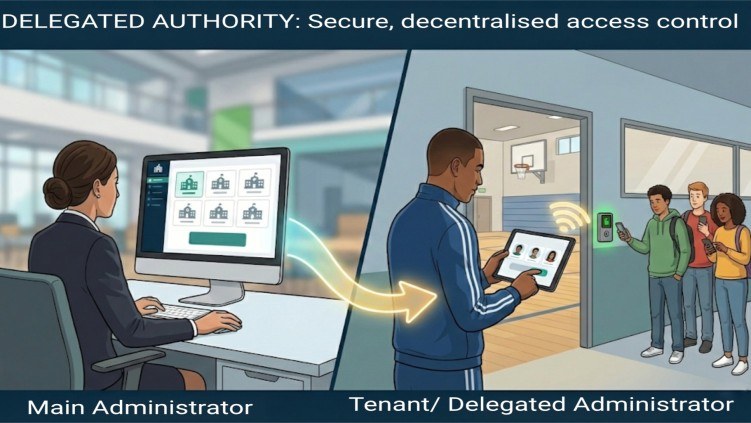
Imagine you are a school. In the evenings, several community groups use your gym and changing rooms — a dance troupe, a martial arts club, a youth theatre. Each has its own roster, its own schedule, its own changing requirements.
Do you release keys and take the security risk? Do you dispatch a janitor for every session? Or do you let each group’s own coordinator manage their members’ access directly — within the boundaries you set — while you retain overall visibility and control?
Until now, that last option wasn’t available — not for schools, not for office buildings, not for any shared space with offline locks.
Today Bitwards launches Tenant Access Manager, a feature of Bitwards Unwired Access that eliminates the centralised key management bottleneck plaguing multi-tenant buildings since the first electronic lock.
Building owners maintain overall policy control. Tenants control their own user permissions and guarantee their users complete privacy.
As far as we know, delegated tenant access management for buildings with offline locks is a world first.
No wires. The phone is the system.
Traditional cloud-based access control requires every lock to be online. Bitwards takes the opposite approach. One of our customers put it well: Bitwards is to access control what Starlink is to internet access.
There is no network middleman between the mobile phone and the lock. And the lock can be completely offline.
Permissions update on the user’s phone in the background. The lock recognises and decrypts the Bitwards token. The token not only grants access but also delivers new, administrator-specified capabilities to the lock — such as updated access policies, new functions, and configuration changes — without requiring a firmware update. The lock then reports its status back to the cloud via the token and the user’s phone.
This patented architecture is why Bitwards works.
The practical consequence: adding a secure, managed door costs an order of magnitude less than legacy systems. A locksmith changes the lock. The platform registers it through the installer’s mobile application. That’s it.
Thereafter the administrator grants access directly to end users, who access through their mobile phones. The building is digital — door by door, at your own pace.
97% of the world’s doors have remained analogue. The high cost of legacy access control methods made it irrational to digitise them. With Bitwards that barrier is gone.
Proof: Aalto University
Universities are the stress test. Aalto University in Espoo, Finland has 15,000 students cycling through every semester and 2,000 doors across multiple campuses — constant churn, departments demanding autonomy over their own spaces, and a facilities team that had been buried in fob logistics.
With Bitwards, departments now manage their own users. When a student graduates, access expires automatically. The system coexists with the legacy access control already in place. Both Aalto and the University of Helsinki chose Bitwards because it required no rip-and-replace — just an architectural layer on top of what they already had.
Bitwards and its integration partners now serve hundreds of customers across Europe.
You don’t have to start over
For buildings that already run a traditional wired access control system, Bitwards coexists with it.
An inexpensive controller fitted near the door connects to the existing system — no panels replaced, no wiring changed, no software migration. Users carry one app that works across both legacy readers and locks.
The investment already in the walls is protected; the new capability layers on top of it.
Why this matters for tenants
Tenant Access Manager doesn’t just reduce administration — it enables better use of shared spaces.
- Each tenant organisation manages users in its own environment, following its own security policies, behind its own credentials.
- No shared database where a breach in one organisation exposes every other tenant.
- Better utilisation of spaces and assets, because access can be configured in minutes rather than negotiated through a facilities desk.
- And for the property owner: full visibility through the audit trail, without touching a single user credential.
- And every user who walks through a door is, in effect, updating the system.
About Bitwards
Built in Espoo, Finland, the Bitwards Unwired Access Platform turns any compatible lock into a cloud-managed access point using the smartphone as sole infrastructure. Other mobile access providers add a smartphone front-end to the wired system already in your building. Without that legacy system, they have nothing to connect to. Bitwards Unwired Access is architecturally unique.
The Bitwards cloud service manages all access control — creating secure tokens, provisioning permissions, maintaining the audit trail. For new doors, the Bitwards Library runs inside the lock’s own firmware — receiving and decrypting a patented two-way token from the phone, and making the access decision locally at the door. For legacy doors, an inexpensive Bitwards controller performs the same role. No new panels, no new wiring, no dependency on any existing infrastructure. This is why Bitwards works on the 97% of doors that other systems can’t economically reach — and coexists with your legacy system where you already have one.
The Bitwards Unwired Access platform can be white-labelled, or forked to run in your own environment.
Eljas Saastamoinen and Mark Linder, Bitwards Oy, 27 March 2026. First published on LinkedIn.